BulldogVSScottish Terrier
A detailed side-by-side comparison to help you choose the right breed for your lifestyle.

Quick Comparison
| Attribute | Bulldog | Scottish Terrier |
|---|---|---|
| Size | medium | small |
| Weight | 18–25 kg (40–55 lbs) | 8–10 kg (18–22 lbs) |
| Height | 31–40 cm (12–16 in) | 25–28 cm (10–11 in) |
| Lifespan | 8–10 yrs | 12–15 yrs |
| Trainability | 2/5 | 2/5 |
| Energy Level | 2/5 | 3/5 |
| Good with Kids | 4/5 | 3/5 |
| Shedding | 3/5 | 2/5 |
| Grooming | 2/5 | 4/5 |
| Apartment Friendly | 5/5 | 4/5 |
| Health | 1/5 | 3/5 |
| Price | $1,500–$4,000 | $1,000–$2,500 |
Attribute Comparison
Temperament & Personality
The Bulldog is known for being docile, willful, friendly, while the Scottish Terrier is typically described as independent, confident, spirited. These distinct personality traits mean each breed offers a different kind of companionship.
Both breeds share a similar playfulness level at 3/5, so you can expect comparable levels of fun and games from either one.
Noise-wise, the Scottish Terrier is more vocal with a barking level of 3/5, while the Bulldog is quieter at 2/5. If you prefer a calmer household, the Bulldog may be the better choice.
Size & Appearance
The Bulldog is a medium breed standing 31–40 cm (12–16 in) tall and weighing 18–25 kg (40–55 lbs). In comparison, the Scottish Terrier is a small breed at 25–28 cm (10–11 in) and 8–10 kg (18–22 lbs).
There's a significant size difference between these two breeds. The Bulldog is considerably heavier, which means higher food costs and the need for more physical space. The Scottish Terrier's smaller frame makes it easier to handle and transport.
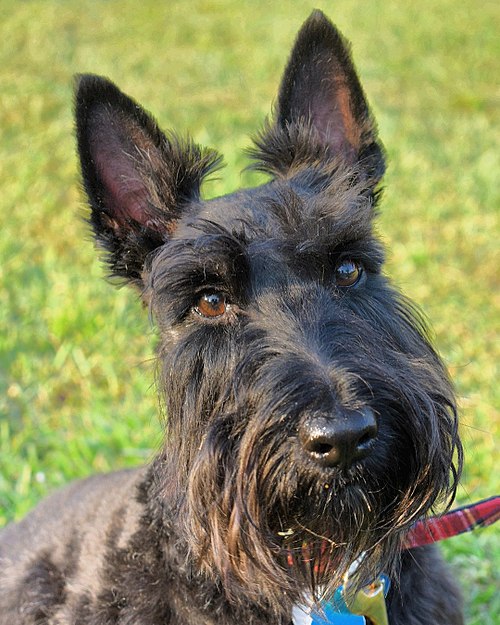
The Bulldog has a short coat available in brindle, white, fawn, red, piebald, while the Scottish Terrier sports a wiry coat in black, wheaten, brindle. Coat type significantly impacts grooming needs and shedding, which we cover below.
Exercise & Activity
The Bulldog has low energy (2/5) with low exercise needs (2/5). The Scottish Terrier has moderate energy (3/5) and moderate exercise needs (3/5).
You'll need to dedicate more time to exercising the Scottish Terrier, which thrives on vigorous daily activity. The Bulldog is less demanding in this regard and settles more easily into a relaxed routine.
For apartment dwellers, the Bulldog is the stronger choice with an apartment-friendliness score of 5/5, compared to the Scottish Terrier's 4/5. The Scottish Terrier generally does better with access to a yard or larger living space.
Grooming & Shedding
When it comes to shedding, the Bulldog drops more fur with a shedding level of 3/5, while the Scottish Terrier is lighter at 2/5. If pet hair on furniture is a concern, the Scottish Terrier will be easier to live with.
Grooming-wise, the Scottish Terrier needs more upkeep (4/5) than the Bulldog (2/5). The Scottish Terrier's wiry coat demands regular professional grooming to stay in top shape.
Annual grooming costs average around $100 for the Bulldog and $300 for the Scottish Terrier. Factor this into your budget when deciding between the two.
Health & Lifespan
The Bulldog has a lifespan of 8–10 years, while the Scottish Terrier lives 12–15 years. The Scottish Terrier generally has a longer lifespan.
The Scottish Terrier is generally the healthier breed, scoring 3/5 for health robustness versus the Bulldog's 1/5. This often translates to fewer vet visits and lower medical costs.
Common health issues for the Bulldog include brachycephalic syndrome, hip dysplasia, cherry eye, skin infections. The Scottish Terrier is prone to scottie cramp, von Willebrand's disease, bladder cancer, craniomandibular osteopathy. Regular vet checkups and health screenings are essential for both breeds.
Annual vet costs average $900 for the Bulldog and $500 for the Scottish Terrier. Pet insurance is worth considering for either breed.
Training & Intelligence
Both breeds are equally trainable at 2/5. Consistent, positive reinforcement methods work well with either breed.
The Scottish Terrier ranks higher in intelligence (4/5 vs 2/5), which can be both a blessing and a challenge. Smarter dogs learn commands faster but also get bored more easily and may develop behavioral issues without mental stimulation.
Regardless of which breed you choose, early socialization and consistent positive reinforcement training are key to raising a well-behaved dog. Puppy classes are a great investment for either breed.
Intelligence Comparison
The Scottish Terrier is the more intelligent of the two, scoring 4/5 to the Bulldog's 2/5. This means the Scottish Terrier generally picks up new commands faster and is better at figuring things out independently. On the flip side, their sharp mind needs regular engagement through puzzle toys, training games, and varied activities to prevent behavioral issues.
These breeds excel in different types of intelligence. The Bulldog leans toward adaptive intelligence — reading human emotions, adapting to new environments, and solving unfamiliar problems. The Scottish Terrier, on the other hand, shows strong instinctive intelligence — excelling at breed-specific tasks through natural instinct rather than learned behavior.
For either breed, mental enrichment is just as important as physical exercise. Puzzle feeders, training sessions, scent work, and interactive toys keep intelligent dogs engaged and prevent the boredom that leads to chewing, digging, or excessive barking.
Family & Social Life
For families with children, the Bulldog is the stronger choice, scoring 4/5 for kid-friendliness compared to the Scottish Terrier's 3/5. The Bulldog's docile nature makes it a natural fit for households with young ones.
If you have other pets, the Bulldog tends to get along better with other dogs (3/5) than the Scottish Terrier (2/5). Proper introductions are still important, but the Bulldog is naturally more sociable with canine companions.
The Bulldog is more welcoming to strangers (4/5), while the Scottish Terrier tends to be more reserved (2/5). If you frequently have guests, the Bulldog's sociable nature will make entertaining easier.
Cost of Ownership
The initial purchase price for a Bulldog ranges from $1,500–$4,000, while a Scottish Terrier typically costs $1,000–$2,500. The Bulldog has a higher upfront cost.
Ongoing annual costs (food, vet, grooming) come to approximately $1,600 for the Bulldog and $1,220 for the Scottish Terrier. The Bulldog is more expensive to maintain year over year, mainly due to higher food costs.
Monthly food costs run about $50 for the Bulldog and $35 for the Scottish Terrier. Over a typical lifespan, the total cost of ownership can differ by thousands of dollars, so it's worth factoring in the long-term financial commitment.
Which Breed Is Right for You?
Question 1 of 3
Do you have children at home?
Frequently Asked Questions
Which is better for families, Bulldog or Scottish Terrier?
The Bulldog scores 4/5 for being good with kids, making it the better family choice compared to the Scottish Terrier's 3/5. Both breeds can be great family dogs with proper training and socialization.
Is a Bulldog or Scottish Terrier easier to train?
The Bulldog is equally easy to train with a score of 2/5, matching the Scottish Terrier. Patience and consistency are important with both breeds.
Which costs more, a Bulldog or Scottish Terrier?
A Bulldog puppy costs $1,500–$4,000 while a Scottish Terrier costs $1,000–$2,500. Annual maintenance runs about $1,600 for the Bulldog and $1,220 for the Scottish Terrier.
Do Bulldogs or Scottish Terriers live longer?
The Bulldog lives 8–10 years on average, while the Scottish Terrier lives 12–15 years. The Scottish Terrier tends to live longer. Proper diet, exercise, and regular vet care help maximize lifespan for either breed.
Can a Bulldog or Scottish Terrier live in an apartment?
The Bulldog is better suited for apartments (5/5) compared to the Scottish Terrier (4/5). It adapts well to smaller spaces.
Related Comparisons
Bulldog vs French Bulldog
See the full comparison →
Bulldog vs Labrador Retriever
See the full comparison →
Bulldog vs Golden Retriever
See the full comparison →
Scottish Terrier vs German Shepherd
See the full comparison →
Scottish Terrier vs Poodle
See the full comparison →
Scottish Terrier vs Rottweiler
See the full comparison →